
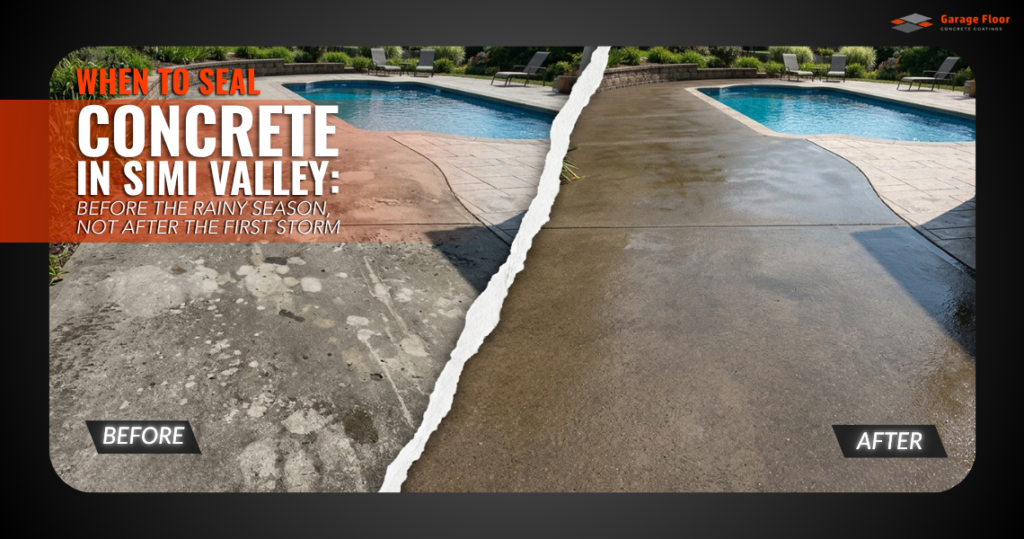
Most of the year’s rain is still ahead of us. The California Department of Water Resources says that, on average, 75 percent of the state’s annual precipitation falls from November through March, which makes late fall the honest answer to when to seal concrete in Simi Valley. A sealer has to bond to a clean, dry slab. Once the storms arrive, a shaded driveway can stay damp for days, and the dry windows between fronts get short and hard to plan around. Garage Floor Concrete Coatings seals driveways, patios, walkways and pool decks across Ventura and Los Angeles counties from its Simi Valley base. The weeks before the first real storm are the easiest time to get the job on the calendar.
Quick Summary: Key Takeaways
- Best window: a run of dry fall days in late October or early November, before the wet months settle in.
- Dry slab first: sealer only bonds to clean, dry concrete, so every storm pushes the start date back.
- Resealing: the company’s guidance for sealed concrete is every 2 to 5 years, depending on sun, traffic and the sealer.
- Pick the system: clear two-component sealer, stain and seal, or a UV-stable polyaspartic coating, matched to the surface.
When to Seal Concrete in Simi Valley: The Dry Weeks Before November
Seal on a stretch of dry fall weather, before the storm season starts. That timing gives the slab a chance to dry out completely after summer sprinklers and lets the sealer bond and cure without a front rolling in behind it.
Wait until January and the math changes. Concrete takes on water and gives it back slowly, and the question-and-answer section on the company’s homepage warns that moisture trapped under a coating leads to bubbling, delamination and efflorescence, the chalky white bloom that creeps across a wet slab. One storm can push the start date back by days. Don’t wait.
Rain Gets Into Unsealed Concrete Before the Damage Shows
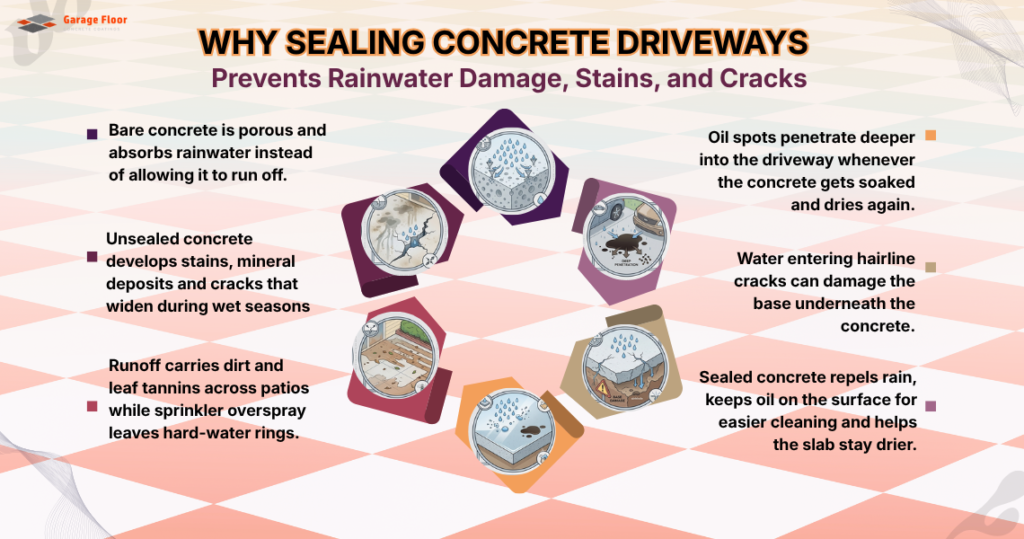
Bare concrete is porous, so rain soaks in rather than running off. In Simi Valley the slab rarely freezes, so the harm is quieter than the frost heave you hear about back east.
It shows up as stains, mineral bloom and cracks that widen a little each wet season. Runoff carries dirt and leaf tannins across a patio, sprinkler overspray leaves hard-water rings, and the oil spot under the car wicks deeper every time the driveway gets soaked and dries again. Water that slips into a hairline crack also works on the base underneath it.
Sealed concrete sheds it. Rain beads up, oil sits on top long enough to wipe away, and the slab stays drier through a wet month.
Sealing a Concrete Driveway Starts With a Dry, Repaired Slab
Preparation decides how long the sealer lasts. A coating laid over damp concrete, an oil stain or an open crack fails first at exactly that spot.
Cracks come first. The company’s exterior coating help page explains that a coating is not a crack repair, and existing cracks should be fixed before anything goes on top. Oil spots need degreasing, and a newly poured patio needs time: the company’s guidance asks for a minimum of 30 days of cure on new concrete, with a moisture meter as the better test of whether the slab is ready.
After all that, the slab still has to dry out completely.
How Often to Seal a Concrete Driveway Comes Down to Sun, Tires and the Product
For sealed concrete, the company’s grind-and-seal page gives a resealing range of every 2 to 5 years, depending on traffic, UV exposure and the type of sealer used. A south-facing driveway that takes full afternoon sun and two cars a day sits at the short end.
The product matters as much. The company notes that hardware-store sealers usually need yearly re-sealing, and its clear two-component sealer is built to avoid that chore.
Test it yourself. Sprinkle water on the busiest strip, usually where the tires turn in from the street. Beading means the sealer is still working, while water that darkens the concrete and disappears within a minute or so means the surface is open again and the next storm will soak straight in.
Patios, Pool Decks and Driveways Around Simi Valley Wear Differently
No two surfaces wear alike. A driveway fights tires, oil and sun; a pool deck takes splash water and pool chemicals; a patio collects planter stains and sprinkler spray.
The company works with three main exterior options. Its two-component clear sealer is made for concrete, exposed aggregate, pavers and brick, built to resist moisture, UV and chemicals. Stain and seal adds color to tired gray concrete. For a harder-wearing finish, an exterior polyaspartic coating goes on in two or more coats, and anti-slip additives can be mixed in for pool decks where bare feet and wet concrete meet. From Wood Ranch to the older tracts near Los Angeles Avenue, the right pick depends on what the slab does every day.
Ask about anti-slip.
Frequently Asked Questions
Q: When is the best time of year to seal concrete in Southern California?
A: Fall. Pick a run of dry days before the November to March storm season, because the slab has to be clean and dry for the sealer to bond and those windows get scarce once winter fronts start arriving.
Q: Can you seal concrete after it rains?
A: Yes, but only after the slab has dried all the way through. Shaded driveways and north-facing patios take the longest. Sealing over trapped moisture is a common cause of bubbling, peeling and white efflorescence.
Q: How often should you seal a concrete driveway?
A: Garage Floor Concrete Coatings’ guidance for sealed concrete is every 2 to 5 years, with sun exposure, traffic and the sealer itself deciding where in that range a particular slab lands. Test yours. Water that beads means it’s still protected, and water that soaks in means it’s due.
Book Your Seal While the Weather Holds
Do the water test this weekend on the driveway, the patio and the pool deck, and photograph each spot where the water soaks in instead of beading. Send those photos to the Simi Valley team. They show the crew which surfaces need prep and which only need a fresh coat. If the slab was sealed before, say so with the photos; the sealer page on epoxyfloorsocal.com notes the system also goes over previously coated surfaces, and the crew will want to know what is already there.