

You want the garage done before the holidays. Family arriving, boxes coming down from the rafters, and a slab that has been dropping grey dust on everything since 2009. Fair enough — that is the reason most garages get done when they do.
The question everyone asks first is how long they lose the garage for. The honest answer is that the coating goes down in a day and the preparation is what takes the skill, and a crew that shortcuts the prep to save you an afternoon has built you a floor that peels in two years. Garage Floor Concrete Coatings is a family-run contractor working across Ventura and Los Angeles counties, CSLB licence 1091373.
Quick Summary: Key Takeaways
- Prep is the job: diamond grinding and surface profiling take longer than applying the coating does.
- Grinding beats acid etching: mechanical profiling is what gives the coating something to bond to, and it is the single biggest reason floors last or fail.
- Autumn adds one variable: slab moisture rises once the winter rain starts, which is what a moisture-mitigating system is built for.
- You need the garage empty: everything on the floor and along the walls has to move out, including the freezer and the shelving.
- Order of operations saves money: cabinets and wall painting are cheaper and cleaner when they are sequenced with the floor, not after it.
The coating goes down in a day; the preparation is the real work
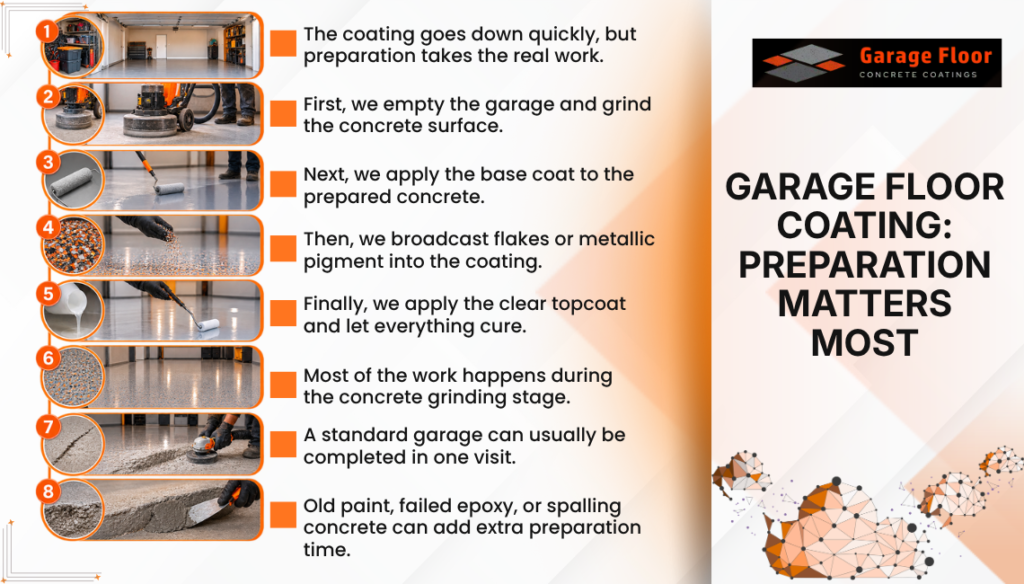
Here is the sequence in plain order: empty the garage, grind the concrete, apply the base coat, broadcast flake or metallic pigment if that is the system you chose, then apply the clear topcoat and let it cure. Grinding is most of that.
Most of that happens in one working visit on a standard residential garage. What varies is the front end — a slab with old paint, a failed epoxy from a previous contractor or spalling near the door takes longer to get right.
Diamond grinding, not acid etching, is what makes a coating stay down
A coating does not glue itself to smooth concrete. It needs a mechanical profile — an opened, textured surface for the resin to key into — and that comes from diamond grinding with a dust-controlled machine, not from a jug of acid and a garden hose.
Acid etching was the shortcut of the 1990s, and it is why so many garages in Simi Valley and Newbury Park have coatings lifting in sheets near the door. The acid roughens the top skin unevenly and does nothing about the sealed surface a power-trowelled slab actually has.
Grinding also tells us what we are working with. Soft concrete, old sealer, adhesive from a floor-tile experiment, moisture staining — it shows up the moment the machine passes over it, which is when the plan gets adjusted.
Slab moisture is the variable that changes once the rain starts
Coatings fail from underneath more often than from on top. Water vapour moving up through a slab pushes on the bond, and if the concrete is wetter than the system allows, the coating blisters weeks later with nothing visibly wrong on the surface. So the system has to suit the slab.
Ventura County gets almost all of its rain in a narrow window. NOAA’s 1991-2020 normals put annual precipitation at Oxnard Ventura County Airport at 12.93 inches, and most of that falls between December and March — so a slab that was bone dry in August can behave differently in January, especially on an older garage poured without a vapour barrier.
What has to come out of the garage, and for how long
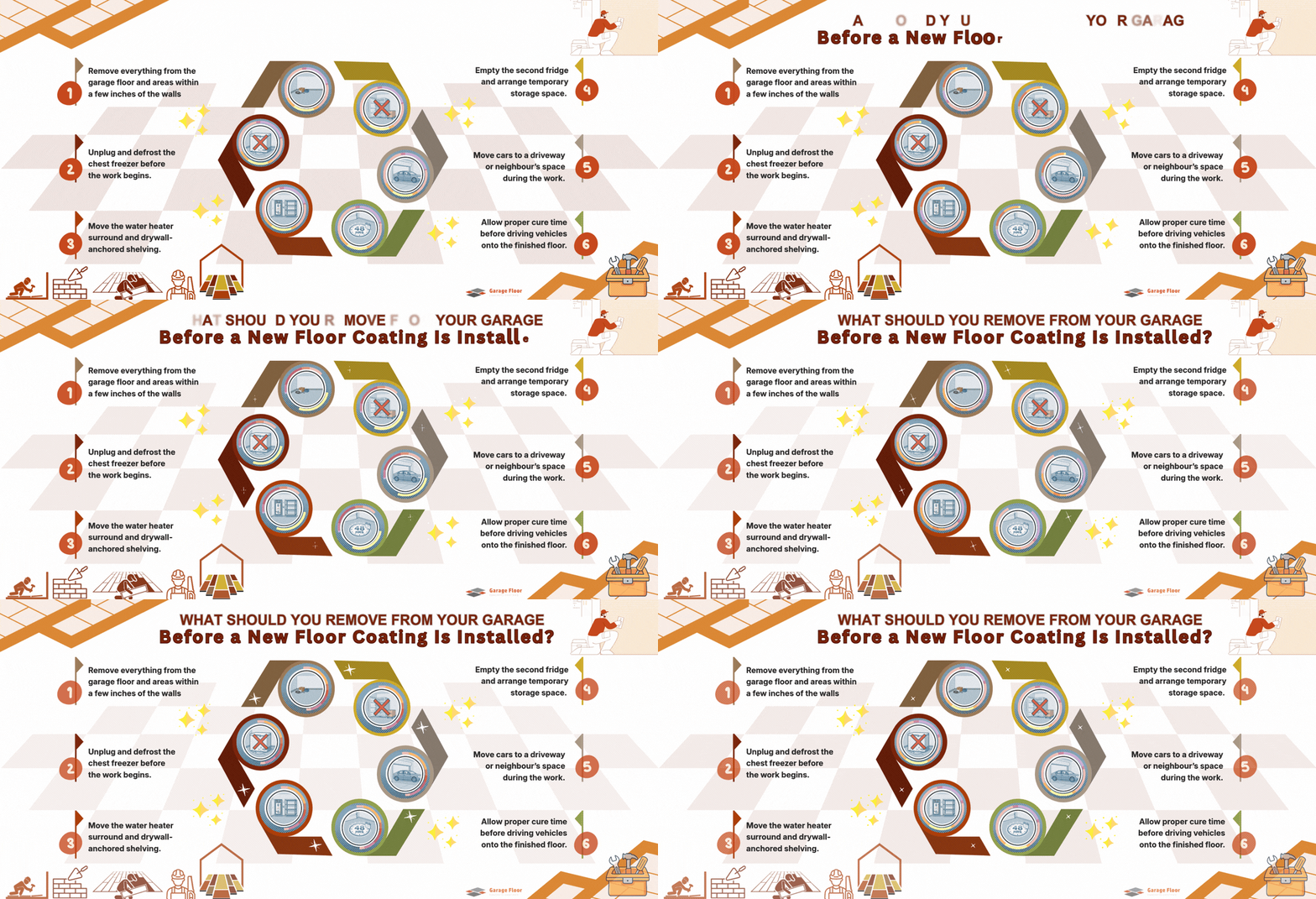
Everything. Not most things — everything on the floor and everything within a few inches of the walls, because the coating runs up to the wall line and the grinder has to reach the edges.
Plan the awkward items in advance: the chest freezer that needs unplugging and defrosting, the water heater surround, the shelving anchored into the drywall, the second fridge full of things. Give yourself a driveway or a neighbour’s space for the cars, and remember the garage door itself needs to be openable while the crew works.
Cure time is the part people underestimate. A floor is walkable well before it is ready for vehicle tyres, and the topcoat chemistry decides how wide that gap is — a 100 percent solids polyaspartic clear coat, which is what we use over our systems, returns to service far faster than a straight epoxy topcoat.
Cabinets and wall painting belong in the same conversation as the floor
Sequence saves money. If cabinets are going in, the floor gets coated first and the cabinets get set on top of it, so you are not paying to cut the coating around a base or leaving bare concrete under a unit you may move in five years.
Wall painting is the opposite. Paint the walls before the floor goes down and the overspray and drips land on concrete that is about to be ground off anyway.
Booking across Ventura and Los Angeles counties before the holidays
The calendar tightens as the holidays get closer. Ask early and you get more choice. Thousand Oaks, Westlake Village, Calabasas, Camarillo, Moorpark, Agoura Hills, Oak Park and Northridge are all inside our normal service area.
One piece of advice from twenty years of this: choose the contractor by how they prepare concrete and how clearly they explain the cure window, not by the colour chart. Every company can show you a pretty flake blend. Far fewer will grind your slab properly before anything goes down on it.
Frequently Asked Questions
Q: How long does a garage floor coating take?
A: On a standard residential garage the grinding and coating usually happen within a single working visit, with cure time afterward before you can walk on it and longer before vehicles go back on. Old paint, failed coatings or damage near the door add preparation time.
Q: Do you have to grind a garage floor before coating it?
A: Yes, if you want it to last. Grinding opens the closed surface of a trowelled slab and gives the resin a profile to bond to. Acid etching is the common shortcut. Lifting coatings near garage doors are the result.
Q: Can a garage floor be coated in winter?
A: It can, with two caveats. Cure times lengthen as temperatures drop. Slab moisture is higher in the rainy months. A garage is a fairly protected environment. So this work continues year-round here.
Q: What do I need to do before the crew arrives?
A: Clear the garage completely, including anything stacked against the walls, defrost and unplug freezers, and arrange somewhere to park. Tell us in advance about anchored shelving, floor drains or water damage near the door.
Get on the autumn schedule before it fills
Send us the dimensions and a couple of photos of the slab and we will tell you what preparation your floor needs and where you fit in the calendar. Estimates cover the grinding, the system and the return-to-service window.
Garage Floor Concrete Coatings — 1445 E Los Angeles Ave, Ste 301Q, Simi Valley, CA 93065
Hours: Mon-Sat 7:00 AM-7:00 PM; Sun closed
Website: epoxyfloorsocal.com