
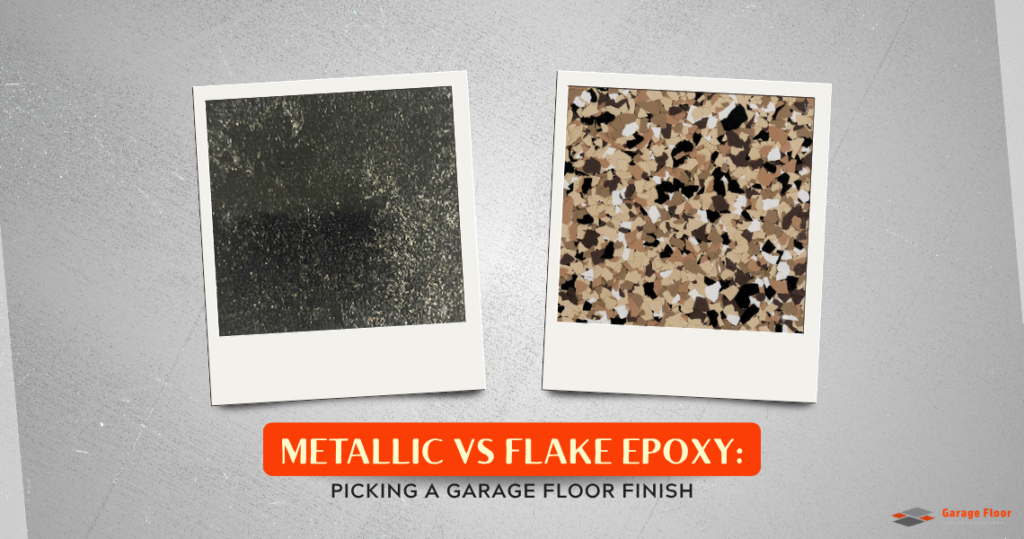
Two garages on the same Simi Valley street, same slab, same square footage. One got a metallic epoxy floor that looks like poured copper; the other got a full-broadcast flake system in gray and black. Four years later, one still looks new and one shows every tire scuff and dropped socket. Guess which.
Both systems are good products. They answer different questions, and the deciding factor is usually how the garage gets used rather than which sample looked better in the truck. Slab moisture matters too, since the EPA recommends keeping indoor relative humidity between 30 and 50 percent to control mold, and a garage slab that wicks moisture will fight any coating on top of it.
Quick Summary: Key Takeaways
- Flake wins for working garages: The chip texture hides tire marks, hairline cracks and dropped-tool chips that metallic puts on display.
- Metallic wins for display space: Home gyms, showrooms and finished garages get depth and movement that flake can’t produce.
- Traction differs: Full-broadcast flake has built-in texture; metallic needs an anti-slip additive in the topcoat to match it.
- Repairs favor flake: A damaged flake area blends back in, while a metallic patch almost never matches the original swirl.
- Prep decides everything: Diamond grinding, moisture testing and crack repair matter more than which finish you pick.
Metallic and flake are built the same way underneath and finished differently on top
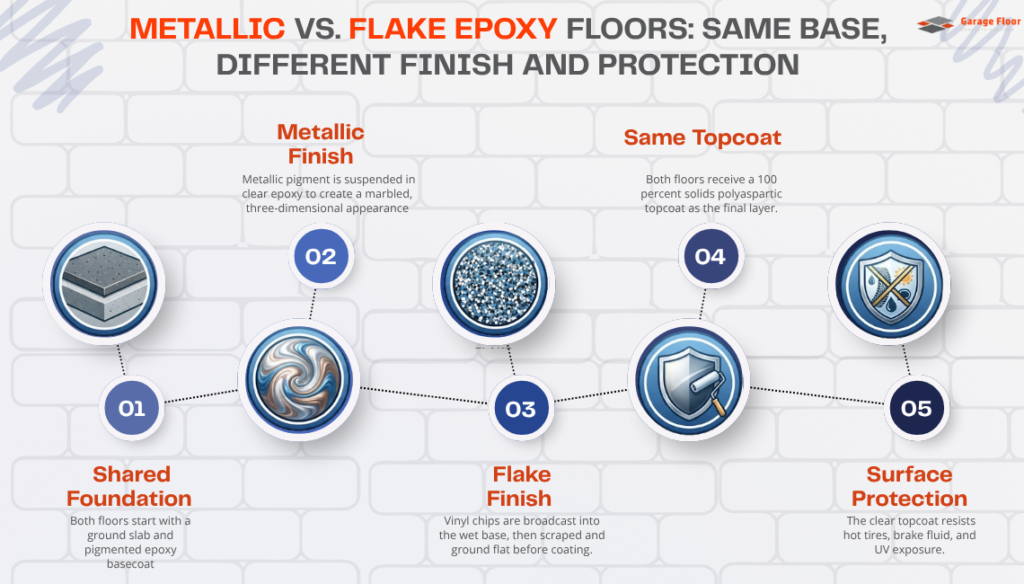
Both start with a ground slab and a pigmented epoxy basecoat. From there they split. A metallic floor gets metallic pigment suspended in clear epoxy that installers move with rollers and blowers while it’s wet, creating a marbled, three-dimensional look. No two come out alike.
A flake floor gets vinyl chips broadcast into the wet base until the surface is fully covered, then scraped and ground flat before the clear coat goes on. Both finish with a 100 percent solids polyaspartic topcoat. That clear layer is what actually resists hot tires, brake fluid and UV.
A working garage should get flake, and the reason is dirt
Flake hides things. That’s the honest sell. The chips break up the surface visually, so tire scuffs, a dropped wrench, dust off a Santa Ana wind, and the hairline crack that opens in year three all disappear into the pattern.
A solid metallic floor does the opposite. It behaves like a mirror, and mirrors show everything, including the reflection of one oil drop under a Camaro. If your garage holds a truck, a tool chest, kids’ bikes and a chest freezer, full-broadcast flake is the right call. Cleanup is a hose and a squeegee. It’ll look the same in year eight.
Metallic belongs in the garages people actually spend time in
Metallic earns its price in finished spaces. Home gyms, converted studios, car collections under lights, showrooms in Thousand Oaks and Calabasas: anywhere the floor is part of what people look at, a copper or charcoal metallic pour reads as a designed surface rather than a coated slab.
The depth is real, not printed. Light moves across it differently through the day, which a sample chip can never show you and part of why customers who see one in person stop considering anything else. It costs more. It also costs more to repair, and it needs an anti-slip additive if the space ever gets wet.
Traction and repairability separate the two more than looks do
Slip resistance is the practical difference. Full-broadcast flake ends up with a light texture from the chips, roughly like fine sandpaper, and that texture keeps its grip when a wet car drips onto it after a February storm. A smooth metallic floor is slick when wet unless we work aluminum oxide or a polymer grit into the topcoat, which changes the feel and slightly dulls the shine.
Repairs go the same direction. A gouged flake floor gets patched, re-chipped and re-coated in a section, and nobody finds it later. A damaged metallic floor usually needs the whole bay redone because the swirl pattern can’t be recreated.
Prep is the part that determines whether either system lasts
Neither finish survives bad prep. The slab gets diamond-ground to open the pores, not acid-etched, which leaves a weak profile and is the single most common reason a big-box kit peels inside a year. Cracks and control joints get cut, filled and reinforced.
Moisture gets tested, because a Ventura County slab poured without a vapor barrier in 1978 can push vapor up through a coating and blister it. The fix is a moisture-mitigating primer applied first. Oil-stained concrete gets degreased and sometimes ground deeper. Then coating starts. Skip any of it and the warranty means nothing.
Fall is the easiest season to book a garage floor in Ventura County
September through November is our smoothest window. Daytime temperatures in Simi Valley and Camarillo settle into the 70s and 80s, humidity drops, and polyaspartic cures predictably without the flash-off problems a 100-degree August afternoon creates. Two days, tops. Light foot traffic after 24 hours; vehicles back in after 72.
Getting it done before the holidays also means the garage is empty and usable when you need it for storage and guests, which is not true in December. We’re licensed with the CSLB, family-run out of Simi Valley, and residential work carries a lifetime warranty.
Frequently Asked Questions
Q: Is metallic epoxy or flake better for a garage floor?
A: Flake for a garage you park in and work in, metallic for a finished space you mostly look at. Flake hides tire marks and small chips, while metallic shows them.
Q: How much does a metallic epoxy garage floor cost compared to flake?
A: Metallic typically runs several dollars more per square foot than full-broadcast flake because of the extra material and the hand work in the pour. Both come in well under a tile or polished-concrete install.
Q: Is metallic epoxy slippery?
A: Smooth metallic is slick when wet unless an anti-slip additive goes into the polyaspartic topcoat. Flake systems get their texture from the chips themselves.
Q: How long does a garage floor coating take to install?
A: One to two days for a standard two-car garage. Foot traffic after about 24 hours and vehicles after 72, depending on temperature.
Get a quote on your Ventura or LA County garage floor
Send photos of the slab or set up a walkthrough, and you’ll get a straight recommendation on flake versus metallic for how you actually use the space.
Garage Floor Concrete Coatings — 195 E Easy St Unit H Simi Valley, CA 93065
Hours: Mon-Sat 7:00 AM – 7:00 PM, Sun closed
Website: epoxyfloorsocal.com