
July in Simi Valley bakes. By 2 p.m., the pavement on Los Angeles Avenue shimmers, and a closed garage can push well past 100 degrees. Homeowners keep asking us the same thing: will that heat wreck a fresh epoxy or polyaspartic floor? Fair question. Heat is real, and it does change how a coating goes down, because the pot life shrinks, the resin kicks faster, and a rushed crew leaves bubbles and roller marks behind that no amount of buffing will hide. Handled right, though, summer is one of the best windows all year to coat a garage in Ventura County. The trick is controlling the slab, not fighting the calendar.
Quick Summary: Key Takeaways
- Heat speeds the cure: Above 85 degrees, epoxy and polyaspartic kick faster, cutting the crew’s working window from an hour down to minutes.
- The slab beats the air: We coat to the concrete’s temperature, not the thermostat, and a shaded ground-floor slab often runs cooler than the afternoon high.
- Summer is prime season: Low humidity and warm concrete help most coatings cure fully in a day, so you park on the floor sooner.
- Timing dodges the peak: Early-morning starts, closed doors, and fans let us slip past the 3 p.m. heat on the worst weeks.
- Prep decides it all: Diamond grinding and a dew-point check stop the bubbling and peeling that DIY summer jobs are famous for.
Heat Changes How a Coating Cures, Not Whether It Can
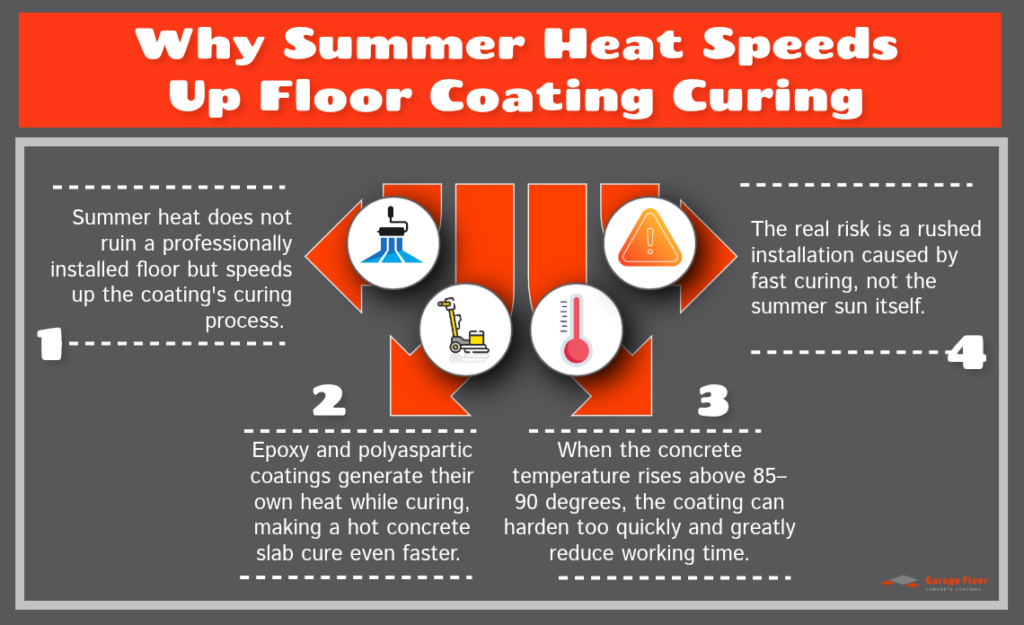
Summer heat won’t ruin a professionally installed floor. It speeds up the chemistry, and speed is the thing we manage. Epoxy and polyaspartic both cure through an exothermic reaction, which means they make their own heat as they harden, so a hot slab underneath just pours fuel on a fire that’s already lit. Per National Concrete Polishing, most epoxy systems want a concrete substrate between 55 and 85 degrees, and once you climb past 85 to 90 the coating can gel so fast that working time collapses from an hour to a couple of minutes.
That’s the whole risk. A rushed pour, not the sun itself.
The Slab Temperature Is What We Actually Measure
We coat to the concrete, not the calendar or the wall thermostat. A garage slab sits on cool earth and holds its temperature far more steadily than the air above it, so at 7 a.m. that floor might read 72 degrees while the afternoon high hits 98. Before a single drop of product goes down, we check the surface with an infrared thermometer across the whole bay.
Numbers, not guesses. Direct sun through an open door can spike a slab 20 to 40 degrees above the air, which is exactly why we keep the door shut and the space shaded while the crew works.
Summer Is Actually the Easy Season in Ventura County
Dry heat is a coating’s friend. Simi Valley afternoons run low on humidity most of the summer, and low moisture means fewer adhesion problems and a cleaner cure than a damp morning ever gives you. Warm concrete also drives a fast polyaspartic cure, often walk-on by evening and park-on inside 24 hours.
We like summer. Compare that to a 50-degree January slab, where cure times can stretch past 72 hours, and you’re stuck parking in the driveway for three days.

Timing and Airflow Beat the Afternoon Peak
The fix for extreme heat is scheduling, not luck. On a 100-degree week, we start at first light when the slab is coolest, then sequence the pour so the fast-setting sections go down before the resin has any reason to rush. Box fans move air and pull heat off the surface, the door stays closed against direct sun, and on the rare brutal day we split the work across two mornings rather than fight a slab that’s cooking.
A rushed crew leaves lap marks. A paced one leaves a mirror.
Prep Is Where Summer Jobs Are Won or Lost
No coating outlasts bad prep, and heat punishes shortcuts hardest. We diamond-grind every slab to open the concrete so the resin bonds mechanically, then vacuum, fill cracks, pull oil stains, and check the dew point, because the surface has to stay at least 5 degrees above it or hidden condensation quietly wrecks adhesion.
This is the boring part. It’s also the reason our floors carry warranties from 10 years to lifetime instead of peeling by Halloween.
Frequently Asked Questions
Q: Can you install a garage floor coating during a Simi Valley heat wave?
A: Yes. We shift the schedule to early-morning starts, keep the door closed, run fans, and reach for fast-set polyaspartic products rated for warm slabs. On a 100-plus-degree stretch, we may split the work across two mornings so the coating never cures faster than the crew can lay it. Heat is a variable we plan around, not a reason to wait for winter.
Q: How long before I can park on a new epoxy floor in the summer?
A: In warm, dry Ventura County weather, most of our polyaspartic systems are walk-ready the same evening and ready for vehicle traffic in about 24 hours. Full chemical cure keeps going for a few more days, so we give you an exact timeline for your specific product and slab before we start.
Q: Does summer heat make epoxy peel or bubble?
A: Not when the slab is prepped and the timing is right. Bubbling almost always traces back to moisture in the concrete or a skipped grind, and peeling comes from poor adhesion. Both are prep failures, not heat failures. We grind, test moisture, and check the dew point so heat never gets the opening to cause them.
Q: Is it better to coat my garage in summer or winter?
A: For most Simi Valley garages, summer wins. Warm concrete and low humidity cure a coating faster and cleaner, while a cold winter slab can more than triple the cure time. A heated space changes the math, but for a standard attached garage, a dry summer morning is hard to beat.
Get Your Garage Floor Coated Before the Next Heat Wave
Thinking about a new floor this summer? Get on the schedule now, before the August rush fills every slot.
Garage Floor Concrete Coatings — 1445 E Los Angeles Ave Ste 301Q, Simi Valley, CA 93065
Hours: Monday–Saturday, 7:00 AM – 7:00 PM · Sunday closed
Website: epoxyfloorsocal.com